
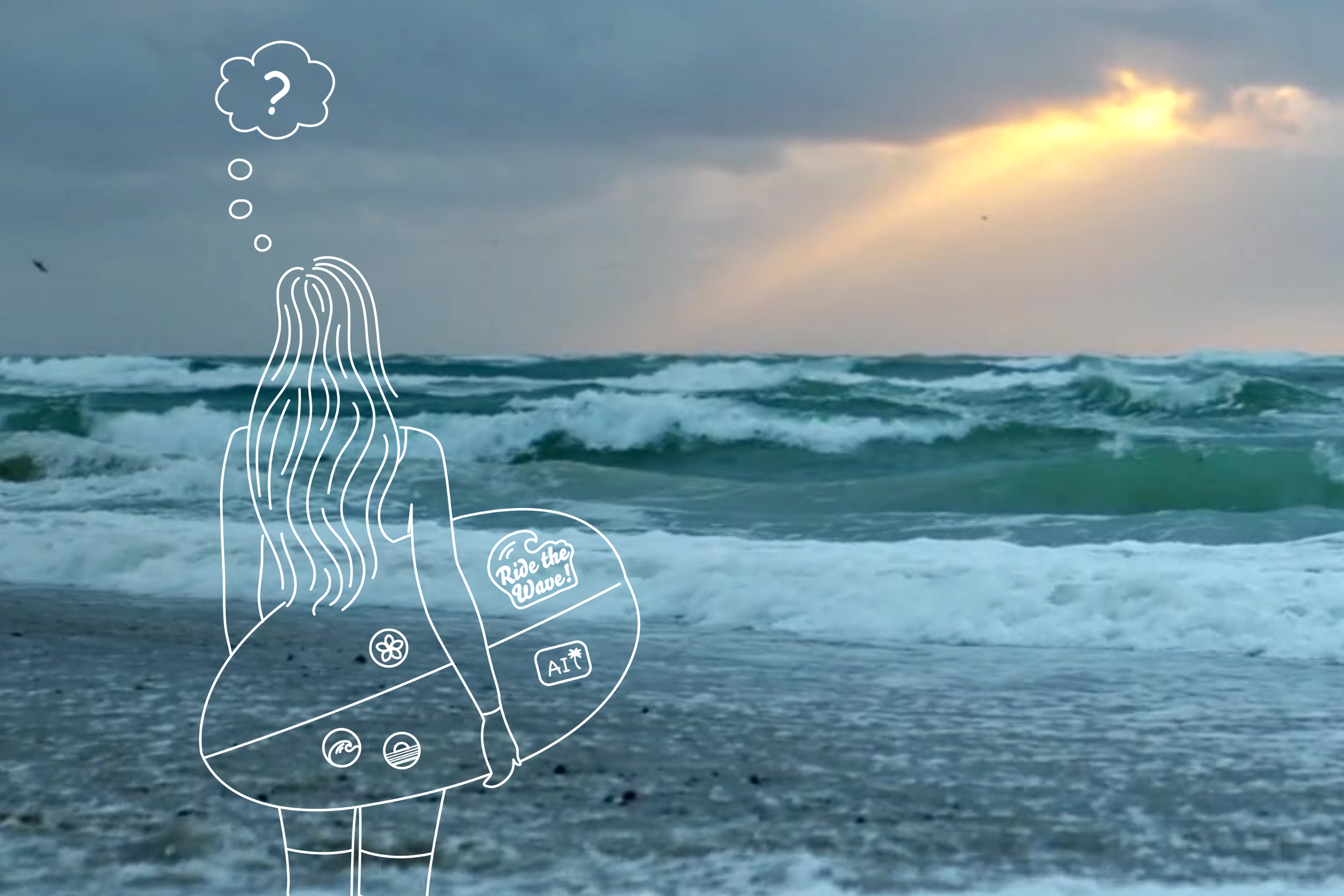
A real look at AI: what it is, what it isn’t, and how people using it effectively have grasped what most people are only beginning to sort out.
A wave can change everything. Then it becomes invisible.
Before I say anything about AI, I think it’s worth looking at some different ways we learn.
I’ve never surfed. Not once. And honestly, it’s never cost me a thing. I don’t live near the ocean. None of my closest friends surf. It’s not part of my world, so the fact that I haven’t learned how has had absolutely zero impact on my life, my relationships, or my work.
But I did learn how to fly fish. Not because someone told me I had to, and not because it was trending, but because it showed up naturally in my life and in the things I love: family, hiking, being outside, slowing way down to be present, my faith. Fly fishing wove itself into who I was growing into, and now it’s just part of how I move through the world.
I learned to lead others in the same way — not because I went looking for it, but because it kept showing up so consistently that eventually it made sense. The same went for how to run a business. Or how to talk about branding in a way that actually resonates with people who don’t think they care about branding or genuinely don’t see the value in it. I learned those skills because they kept appearing in the context of my life and work, and ignoring them would have cost me something real.
AI is starting to feel that way to me. And I suspect for a lot of you reading this, it probably does too.
Then there’s the kind of learning that gets handed to you whether you asked for it or not. When we moved from Ohio to North Carolina in 2020, I knew almost nothing about snakes. My relationship with them was pretty simple: a hard pass. But a new environment has a way of stretching your comfort zone.
We had some land graded and shored up the eroded areas with hay netting blankets to hold things in place and promote regrowth. On a couple of occasions, snakes got stuck in the netting. The first one was dead by the time I found it. I’ve never been a snake person, but knowing something had died because of work I had done didn’t sit right. It bothered me enough to actually learn. By the next time I spotted two snakes caught in the netting, I could identify them, worked them free, and let them go. A completely different outcome, just because I’d taken the time to understand what I was dealing with.
Since moving here I’ve encountered many different species on our property. Finding an eastern diamondback rattlesnake coiled up inside my generator is, to put it mildly, a lot. But that’s exactly where knowledge earns its keep: knowing what you’re looking at, knowing not to panic, knowing what to do next.
The learning went in both directions. Snakes like the eastern racer, the eastern indigo, and the common kingsnake are natural predators of venomous species and worth keeping around. Knowing that changed how I think about the whole ecosystem here. It’s not about eliminating everything that makes you uncomfortable. It’s about understanding what belongs and why.
I still take precautions. I maintain safe zones for the kids. But I’m no longer operating out of pure fear and a “heck no” response, because that approach had already cost me something. Knowledge didn’t make me fearless. It made me useful and intentional. It encouraged me to learn.
That’s the version of learning I keep coming back to when I think about AI. Not the kind where you become an expert for the sake of it. The kind where your world changes around you and you decide, intentionally, to understand it well enough to navigate better than you would have otherwise.
Some things you learn because you’re drawn to them. Some you learn because your world changes and the cost of not knowing becomes real. Both count. And if the wave is already in your backyard, you probably need to learn how to surf.
We’ve Been Here Before
I keep coming back to the idea that every generation has lived through its own version of this moment. The moment in which something so world-altering, so significant, has arrived and is going to change everything … but then quietly becomes the floor we all stand on without a second thought. Think about the internet. Stock photography. Google Search. The cloud. Website page builders. This list goes on.
Each of these innovations brought about the same collective concern and uncertainty. Each one created winners and people who got left behind. And each one, eventually, just became the new normal.
Not using AI is not going to leave you behind, unless the world you operate in starts to run on it. And here’s the thing — for a lot of us, it already is.
To this day there are people who don’t fully know how to use Google Search. Not because they’re unintelligent, but because Google crashed into the internet like a wave and those folks never learned to ride it. They get by, but they work harder for worse results than someone who knows how to interact optimally.
And here’s the part nobody talks about enough: The people who over-relied on new tools got called out, too. Remember when Squarespace and Wix made it possible for anyone to have a website? That was genuinely useful. But it didn’t take long before people began noticing when websites felt “off” or templated. The tool got the job done, technically. But it wasn’t personal. It wasn’t intentional. And it showed.
The same thing happened with stock photography. There was a moment when having polished images on your website (any images) felt like a win. Then people’s eyes and expectations adjusted. Now most of us can tell within a second whether a company actually photographed their team, their space, or their product, or grabbed something from iStock that kind of, sort of, vaguely matched their vibe. The stock photo ticked the box of having a photo. But it quietly communicated something else: We didn’t care enough to make something real.
In our industry, search engine optimization, or SEO, is probably the clearest example of this pattern. When people figured out you could game search rankings, everyone lost their minds. Suddenly agencies were selling SEO as if it were a magic bullet. Stuff your keywords, buy some backlinks, and watch the leads roll in. And for a while, those tactics worked.
Then Google and audiences got smarter, and the people who had been chasing the algorithm instead of building something real were exposed as snake oil peddlers. The shortcuts stopped working. A lot of people got burned and decided SEO was a sham — a belief some still hold onto or encounter in the wild today.
But here’s what actually happened. The floor rose. The people who understood what SEO actually was — not a trick, but a way to make quality content findable — kept building and iterating, and as a result, kept winning. For those players, it was never about gaming the system. It was about understanding how people search for topics and making sure your relevant content showed up when they did. The goal was to attract eyes to content worth reading and then let the person decide for themselves. And if you set aside all the opinions about Google and just look at its overarching goal, it’s pretty simple: Serve up the most relevant, highest-quality content for whatever someone is searching for. The people who built toward this goal have done fine. The ones chasing shortcuts didn’t.
Though blackhat SEO practices have diminished over time, there are still people trying to use SEO the old way. There are still agencies selling it like snake oil. And there are still people who wrote it off entirely and are leaving a real opportunity on the table. Sound familiar?
AI content is already heading down the same road as SEO. The people who use it to generate all their copy (captions, blogs, emails, brand voice) without adding a human editorial layer are already being sniffed out. The cadence is off. The specificity is missing. It reads like a very confident version of nobody in particular.
And the same thing is happening with imagery. AI-generated visuals are everywhere right now, and people are starting to spot them: the hands are wrong, the lighting feels synthetic, the whole thing has a polish that somehow still manages to feel empty. Audiences, even ones who can’t explain why, can feel when something wasn’t made by a person who actually cared about it. That feeling doesn’t lie.
The real danger isn’t that people use AI too much or too little. It’s that AI can encourage apathy. The more embedded it becomes in everything we do, the easier it is to just stop questioning it. To run with whatever narrative confirms what you already believe and call it research. To hit the “easy” button of copy and image generation and barely glance at the results. To scan a summary of research without bothering to verify if the source is credible.
That’s not an argument against using it. It’s an argument for better understanding the technology and staying awake and aware while you do.
Personal Computer
Why would I ever need one at home?
Most people couldn’t fathom owning a computer. Businesses that adopted them early rewired how they worked entirely. Typesetters, draftspeople, and entire job categories quietly disappeared.
The Internet
A trend for academics and casual nerds.
Email replaced the memo. Google replaced the encyclopedia. Amazon replaced the mall. Companies that saw it as a new distribution channel thrived. Those that saw it as a threat mostly didn’t.
Stock Photography
The death of photography as a profession.
All of a sudden, anyone could purchase polished photos without hiring a photographer. Then our eyes adjusted. People could tell in a second if a company used real photography or grabbed something from iStock. Authenticity became visible.
Google Search
Too much information that’s impossible to process.
Using search well was (and still is) a real skill. Users could now find anything — answers to questions, details about businesses, large repositories of knowledge — in minutes. (Today, AI early adopters and power users will have the same edge over casual users that power searchers had then.)
The Cloud
You want me to put my data where?
IT departments resisted … and then adapted. Now “the cloud” is just called “software.” Companies that embraced it early built massive advantages in speed and scale.
Artificial Intelligence
This time it really does feel like everything will change.
AI won’t replace pure human creativity, core situational judgment, or authentic relationships. But it will replace the version of any role that doesn’t evolve. Sound familiar? It should.
So Where Does That Leave Marketers Using AI?
We’re still right in the middle of the same story. Except this time, the internet has given us all front-row seats and the ability to amplify everyone’s reaction to it in real time. It’s loud out there right now. The fear is real. The confusion is understandable. And somewhere underneath all of it is a genuinely useful set of tools that, when used well, can give you back hours of your week and make your work meaningfully better.
But here’s where I want to be honest with you, because I think the honest version of this is more useful than anything else.
Yes, AI is streamlining and even eliminating certain tasks in our industry. Some of those tasks used to be someone’s job, and that’s not a small thing. If you’re feeling that pressure right now, whether that’s a client turning to AI to produce something they used to hire you for, or a company leaning so far into automation that the human voice has gone completely missing, that’s real.
But what makes you good at your discipline doesn’t come from a tool. It comes from years of showing up, paying attention, and developing a point of view that nobody else has. The companies going all-in on AI-generated everything are already being sniffed out. Your job right now isn’t to out-automate anyone. It’s to be so clearly, distinctly human in your work that the difference is impossible to ignore. This deserves its own conversation, and we’re having it.
The people who ignore AI entirely will work harder for slower results. The people who outsource their thinking to it will produce work that sounds exactly like that, outsourced.
Both of those are losing positions. And the sweet spot (the one that’s always existed with every tool, every wave, every new thing) is learning it well enough to use it intentionally. To use it as an amplifier of what’s already distinctly yours. And to know, always, when to put it down and just think.
But Wait: What Do I Even Need to Know about AI?
Before we go any further, I want to take a second to actually explain what we’re talking about, because “AI” has become a catch-all term that means everything and nothing at the same time.
From what I’ve learned, there seem to be five distinct layers to this landscape. Understanding them changed how I thought about them and how I am using them. Here’s a look at each type:
Raw engines like Claude, GPT-4, and Gemini. You never interact with them directly. They’re always wrapped inside something else. Think of it like an engine under a hood.
- Claude
- GPT-4o
- Gemini
- Mistral
- Llama
Tools you actually open. They wrap a model with a UI, possibly a login, and history. Perplexity, Claude.ai, and ChatGPT are all applications. The model is the engine; the application is the car.
- Perplexity Pro
- Claude.ai
- ChatGPT
- GitHub Copilot
For companies building AI-powered products, platforms handle deployment, security, and monitoring. You’re unlikely to use these directly, but the apps you use often run on top of them.
- AWS Bedrock
- Azure AI Studio
- Vertex AI
- Anthropic Console
Think of these as the transmission. The engine runs, but automations push the power to the wheels without you needing to manually shift every time.
- LangChain
- Zapier AI
- AutoGen
- LangGraph
Apps you already use that have added AI. Notion didn’t become an AI company. It added AI writing assistance. Same with Slack, Gmail, Google Docs, etc.
- Notion AI
- Slack + Claude
- Gmail AI
- Google Docs AI
But What If I’d Prefer to Avoid AI Altogether?
Both of my daughters are in public school, and the AI conversation has become a focus at home. Most of the time, the school’s position lands as a blanket “you can’t use it,” and I understand where that thinking comes from. When you don’t fully understand something, avoiding it feels like the safer call. I have real empathy for that.
But avoiding AI isn’t the answer. How do I know? Well, we’ve been here before. When calculators showed up in the 1970s, society debated whether students should be allowed to use them — the concern being that they’d never learn the math behind the results. Here’s what actually happened: People who learned how to use a calculator, and spent the effort to understand the math behind it, pulled ahead. The ones who were shielded from calculators didn’t have the same advantages.
Then the internet showed up, and some educators had a similar response: Go to the library instead. That didn’t make the work better. It made it harder and slower, and it produced lesser results. We know how that played out.
The pattern is the same every time. The concern is legitimate. The blanket ban never works.
When it comes to using AI, I believe one of the initial concerns people are having is that people who use it will stop at the first result and calling it done. No critical thinking, no verification, no real understanding of where the answer or result came from. That’s a legitimate concern. But the response to that isn’t to ban the technology as a whole. It’s to understand how to use it and when and where it shows up.
Perplexity, for example, isn’t some mysterious AI oracle. It’s a front door to the internet, just like Google, except it provides a faster, higher quality of engagement with more depth to the results. Knowing that changes how you interact with it. You check sources. You fact-check. You treat it like a starting point, not a finish line.
When the new wave hits our doorstep, we need to learn how to use these tools well. Because the world we’re walking into may already run on them.
How CreativeFuse Thinks about AI: Intentionality, Care, and Knowledge
Simple as it sounds, most people are either avoiding AI entirely or going way too far with it, and it usually comes down to skipping one of these:
Intentionality means knowing why you’re opening it before you do. AI without a clear purpose produces output without a clear point. It’s the content equivalent of a shrug. If you can’t articulate what you want to accomplish, the tools can’t help you accomplish it.
Care is what separates work that feels human from work that doesn’t. Your audience (a client, a reader, a customer) can feel the difference between something made with attention and something you’ve churned out. That feeling is your competitive advantage, and no model can replicate it.
Knowledge is knowing what only you can bring to an effort or project, and knowing what the tool can’t or shouldn’t do. This is your judgment, your relationships, your perspective, your creative instinct. The things that took years to develop and can’t be prompted into existence. Let the machine handle what would only slow you down. Guard the rest like it’s your most valuable asset — because it is.
But knowledge doesn’t show up on its own. You have to choose to go soak it in. Spend an hour with one of these tools this week, not to produce anything, just to understand it. Ask it something you already know the answer to. Push back on it. See where it breaks down. That’s how you figure out where it actually fits in your work and where it doesn’t. The people who are using it well aren’t smarter than you. They just started learning these nuances earlier.
How I Created This Article
I’ll be honest with you, it would be pretty hypocritical to write a whole piece about using AI with intention and then not show you how this one came together.
The thinking is mine: the stories, analogies and examples, the three-word framework, the two positional extremes most people take with AI, the desire to map out AI types. I worked through all of these ideas before I opened a single tool. That part didn’t get “outsourced.” But once I knew what I wanted to say, I used AI to move faster on the parts that would have slowed me down — like research, article structure, early section drafts, and the visual elements you’ve been interacting with.
What came after that was a lot of back and forth. Reframing, pushing back, rewriting things in my words, cutting things that sounded like AI. The version you’re reading went through probably a dozen rounds of revision before it even reached our editing team, who helped me further refine my ideas, reviewed every line of copy, and proofread for errors and typos.
That’s the real process. Nothing magic about it.
It started with an observation, not a prompt
I kept seeing and hearing AI conversations that lacked historical context, treating it like something unprecedented when every generation has lived through some version of this. That was the seed of the idea for this article. AI wasn’t even involved yet.
I shaped the points I wanted to share before opening any tool.
Two losing positions. The sweet spot. The examples. Intentionality, care, and knowledge. The stories and the metaphors. All of that was mine before a single tool was opened.
I started “prompting,” got a draft, pushed back, and iterated.
Perplexity helped hone my research. Claude.ai produced first passes of the wave descriptions. Some were close, and some read like a Wikipedia entry. I continued to iterate, aiming for more human, natural-sounding language — something written in my words.
I began using Claude.ai to create rough visuals or first drafts of interactive elements used in this article.
The taxonomy came from a real conversation.
I didn’t start with a five-layer framework for breaking down the types of AI. It emerged through back-and-forth engagement with the AI tools. I started by asking what the difference was between Claude and Perplexity:
- So Perplexity isn’t a model. It’s more like a front door that uses multiple models including Claude?
- Can you help me map out all the categories of AI tools so I actually understand how they relate?
I continued to push, and we visualized it together. I then finished by fact-checking and digging into research of additional examples of each of these AI layers. And wouldn’t you know it, I learned some more about how and when AI can be used that I hadn’t known before
Editorial calls were made by me and the team.
What to cut, what to keep, what sounds like me and what doesn’t. AI never made those calls.
Purely mine + the team
- The personal stories, analogies, metaphors and framing
- The core argument about two losing positions
- Intentionality, care, knowledge as the framework
- The decision to be transparent about the process
- Every pushback and editorial cut
AI-assisted
- Historical research on each technology wave
- First drafts of wave descriptions and outcomes
- The AI taxonomy breakdown and layer definitions
- Building the interactive visuals and animations
- Structure and flow of thoughts and information
The wave is real. But it still doesn’t surf itself.
Our Thoughts on AI, Simply Put
I’m not going to tell you to use AI. I’m not going to tell you it’ll change your life or that you’re falling behind. That’s not how I like to approach anything — not work, not technology, not relationships. What I’ll say is this: If it keeps showing up in your world, in the work your clients are asking about, in the conversations your team is having, in the tools your industry is building around, that’s worth paying attention to.
Not because you have to. But because the people who engage with it thoughtfully (with intentionality, care, and some earned knowledge about what they’re doing) are going to do better work faster while the people on either extreme will be exhausted by shallow results and missed opportunities.
And the ocean’s not going anywhere.